A tredge is a combination of three edges.
A wing-edge is an edge piece adjacent to a corner.
A centre-edge is an edge piece between two wing-edges.
Solve edge-centres (centre crosses)
-
Edge-centre at front:
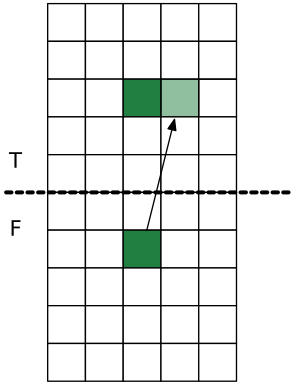 (R r) F (R′ r′)
 -
Edge-centre on bottom:
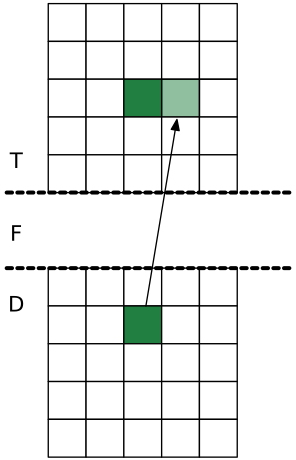 (R2 r2) F (R2 r2)
Solve corner-centres (centre crosses)
-
Corner-centre at front:
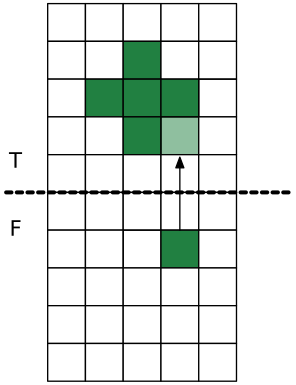 (R r) U (R′ r′) U (R r) U2 (R′ r′)
 -
Corner-centre on bottom:
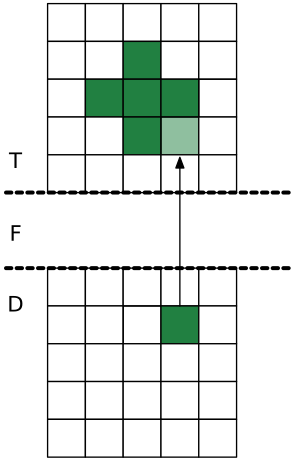 (R2 r2) U (R2 r2) (R2 r2) U (R2 r2) U2 (R2 r2)
Find a wing-edge at uLF:
Find the other wing-edge with the same two colours, and pair it up with the wing-edge at uLF:
-
If the other wing-edge is in the top layer:
turn the U-layer so that the wing-edge is at the front.
-
Apply one of the following algorithms to pair the two wing-edges:
-
Colours match.
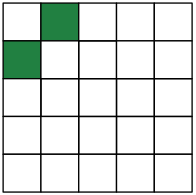 R U′ R′ (D′d′)
 -
Colours do not match.
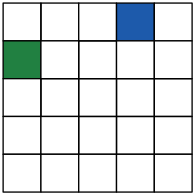 U′ F′ U F (D′d′)
-
-
If the other wing-edge is in the bottom layer:
turn the D-layer so that the wing-edge is at the front.
-
Apply one of the following algorithms to pair the two wing-edges:
-
Colours match.
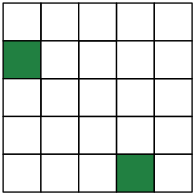 R′ D R (D′d′)
 -
Colours do not match.
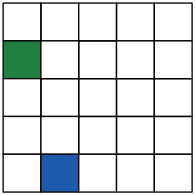 D F D′ F′ (D′d′)
-
If the other wing-edge is in the middle layer, store it in the top layer per substage 3, then solve using one of the algorithms above.
Find the centre-edge that matches the paired up wing-edges, and add it to the wing-edges to make a solved tredge:
-
If the centre-edge is in the top layer:
turn the U-layer so that the centre-edge is at the front.
-
Apply one of the following algorithms to pair the two wing-edges:
-
Colours match.
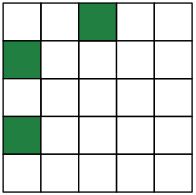 R U′ R′ (U′ u′) (D′d′)
 -
Colours do not match.
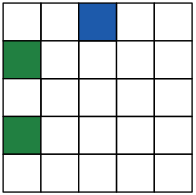 U′ F′ U F (U′ u′) (D′d′)
-
-
If the centre-edge is in the bottom layer:
turn the D-layer so that the centre-edge is at the front.
-
Apply one of the following algorithms to pair the two wing-edges:
-
Colours match.
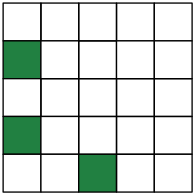 R′ D R (U′ u′) (D′d′)
 -
Colours do not match.
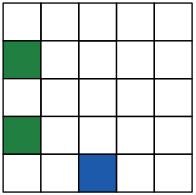 D F D′ F′ (U′ u′) (D′d′)
-
If the centre-edge is in the middle layer, store it in the top layer per substage 3, then solve using one of the algorithms above.
Hold the cube with the solved tredge at FR.
Turn U-layer so that an unsolved tredge is at UF, and perform the following algorithm:
This will swap the unsolved tredge at FR with the solved tredge at FR. If all four edges are or become solved in the top layer, turn the cube upside down and start storing edges in the new top layer.
Solve the cube using any 3×3×3 method.